

In modern engineering, the ability of a material to withstand impact is a critical factor in the design of structures, vehicles, protective equipment and industrial components. The dynamic impact tests allow to evaluate how materials and structures respond to rapid and energetic loads, simulating extreme conditions that could jeopardize the integrity of a system.
This article delves into methods for measuring energy absorption in impact testing, the differences between low and high speed testing, and key applications in the development of safety and shielding materials.
Evolution of Dynamic Impact Testing: From Theory to Advanced Practice
In the previous article, we explored the basic fundamentals of the dynamic tests. Now, we focus on how these tests have evolved to meet today's technical demands.
As technology advances, so do the methods for evaluating the behavior of low-impact materials. Today, dynamic impact tests not only measure the basic strength of a material, but also allow:
- Simulate specific conditions of real applicationssuch as vehicular collisions, explosions or ballistic impacts.
- Analyze the internal microstructure of materials. during impact, using advanced data acquisition technologies.
- Integrating computational models with experimental data to predict behavior in extreme scenarios.
This evolution has been driven by the need to improve safety in critical applications, from the design of safer vehicles to the development of new composite materials with improved energy absorption properties.
Methods for Measuring Energy Absorption in Dynamic Impact Tests
Energy absorption is a critical parameter in impact testing, as it reflects the ability of a material to mitigate damage by dissipating energy during a collision. There are several methods to evaluate this parameter:
Charpy Impact Test
One of the most widely used for metallic and polymeric materials.
- Procedure: A notched sample is struck with a pendulum that releases a known amount of energy.
- Measurement: The absorbed energy is determined by measuring the difference between the initial potential energy of the pendulum and the energy remaining after impact.
- Applications: Ideal for comparing the toughness of different materials and studying the effect of temperature on impact resistance.
Drop Weight Test (Drop Weight Test)
Simulates more realistic impact conditions, such as accidental drops of heavy objects.
- Procedure: A weight is dropped from a given height onto the sample.
- Measurement: Impact energy, residual deformation and possible fracture are recorded.
- Advantages: Allows adjustment of mass and height to vary the impact energy.
Instrumented Impact Testing
They use advanced sensors to record real-time data during impact.
- Measured parameters: Impact force, displacement, strain rate and absorbed energy.
- Benefits: They provide detailed information on the dynamic response of the material, allowing a more complete analysis of fracture mechanisms.
High-Speed Analysis (High-Speed Cameras)
High-speed cameras are used to observe the behavior of the material during impact.
- Advantages: They make it possible to identify critical stress concentration zones and to analyze crack propagation in real time.
- Applications: Tests on composite materials and complex structures.
Contact us with our team of experts for personalized advice and find out how we can improve the accuracy of your tests.
Differences between Low and High Speed Impact Tests
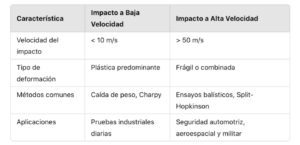
The dynamic impact tests can be classified according to the speed of the applied load. The impact velocity directly influences the results obtained and the interpretation of the data.
Low Speed Impact Tests
- Characteristics: Impact velocities less than 10 m/s.
- Objective: Evaluate plastic deformation, energy absorption and resistance to everyday impact damage.
- Examples: Drop tests of tools on production lines, impacts on electronic devices or packaging.
High Speed Impact Tests
- Characteristics: Speeds higher than 50 m/s.
- Objective: Simulate extreme conditions, such as vehicle collisions, explosions or ballistic impacts.
- Examples: Resistance tests on automotive panels, aeronautical structures and military armor.
Key Differences:
Security and Armor Materials Development Applications
The dynamic impact tests are critical in the development of materials that must protect against severe mechanical damage. Some key applications include:
Automotive Industry
- Energy absorption systems: Evaluation of bumpers, programmed deformation structures and airbags.
- Safety tests: Collision simulation for improved occupant protection.
Aerospace Industry
- Evaluation of structures: Strength of composite materials under high velocity impact conditions, such as space debris impact.
- Dynamic fatigue tests: Wing, fuselage and critical component strength validation.
Armor and Military Security Materials
- Ballistic tests: Evaluation of bulletproof vests, armored glass and military vehicle structures.
- Explosive tests: Simulation of detonation impacts to validate the resistance of active and passive shielding.
Personal Protective Equipment
- Safety helmets: Tests to ensure energy absorption in sports, industrial and military impacts.
- Technical clothing: Evaluation of materials for cut and impact resistant clothing.
Servo Technology for Dynamic Impact Tests
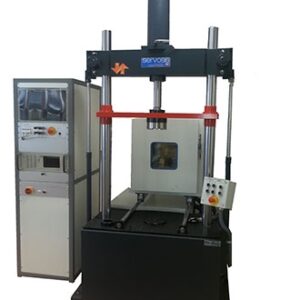
At ServosisWe build high precision equipment for dynamic impact testing, designed to meet the needs of the most demanding industries.
High Speed Impact Systems
- Capable of simulating extreme collisions with precise control of impact energy.
- Adaptable equipment for ballistic and structural impact tests.
Free Fall Test Benches
- Designed to evaluate the low speed impact resistance of industrial components.
- Highly sensitive sensors to record deformation and energy absorption in real time.
Advanced Analysis Software
- Enables high-resolution impact data acquisition and analysis.
- Integration of high-speed cameras and deformation sensors for a complete analysis.
The dynamic impact tests are critical to ensure the safety and reliability of materials and structures under extreme conditions. Understanding energy absorption capacity, the differences between low- and high-velocity impacts, and their industrial applications is essential for the design of safer and more efficient products.
At ServosisWe offer advanced technological solutions for impact testing that enable our customers to obtain accurate and reliable results. Contact us. for more information on how we can help you optimize your dynamic testing processes.