

When we design a component for the real world, we know that loading conditions are rarely simple. A car frame, a hip prosthesis or the structure of a landing gear undergo combined tensile, compressive and torsional loads that are applied simultaneously and dynamically.
To correctly predict their behavior, a classic uniaxial fatigue test is not enough: multiaxial fatigue tests come into play.
Today we will take a closer look at what they consist of, how they are performed, what challenges they pose and why they are essential for highly demanding industrial sectors.
What are multiaxial fatigue tests?
Multiaxial fatigue tests are tests in which materials or components are subjected to multiple types of loads applied simultaneously:
- Tension and torsion,
- Compression and torsion,
- Combined biaxial or triaxial forces.
While traditional uniaxial tests only act a load in one direction (e.g. axial tension), multiaxial tests seek to more realistically replicate the stress states faced by the material in service.
In the laboratory, this involves applying combined loads on different axes, with amplitudes, phases and frequencies that can be controlled and modified to faithfully represent the component's operating environment.
Why perform multiaxial fatigue testing?
Limitations of uniaxial tests
The fatigue tests The conventional tests are relatively simple to perform and provide very useful information about the basic strength of a material. However, in most real-world applications, components experience multiaxial loading.
Some examples:
- Automotive chassis: withstands vibration, bending and torsion in combination.
- Aircraft fuselage: receives internal loads due to pressurization and external loads due to aerodynamics, simultaneously.
A uniaxial test may underestimate or overestimate the actual strength, since it does not capture the interactions between different types of stresses.
This can lead to premature failures or unnecessarily oversized designs.
Advantages of simulating realistic loading conditions
Performing multiaxial fatigue tests offers clear advantages:
- Increased accuracy in estimating the useful life of critical components.
- Detection of failure modes that would not manifest themselves in simple tests.
- Optimization of designs to reduce weight and increase safety.
- Regulatory compliance in sectors where realistic load simulation is mandatory (e.g. aeronautics or biomechanics).
Ultimately, it allows us to design and validate products more reliably.
Methods and technologies for multiaxial fatigue tests
Multiaxial testing machines: main features
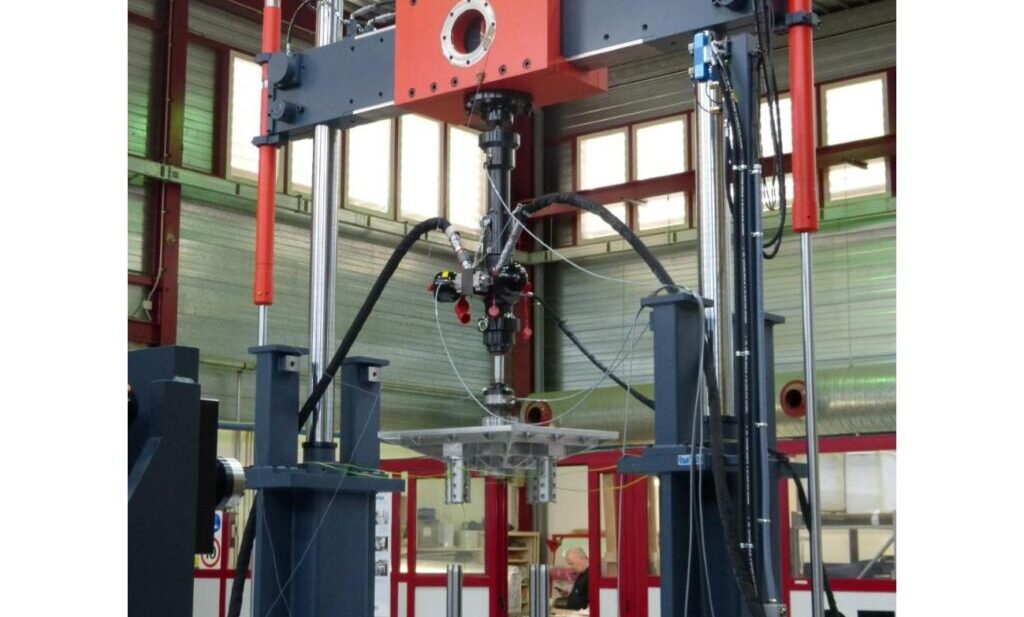
To perform this type of testing, specialized machines capable of applying and controlling loads on more than one axis simultaneously are required.
Key features:
- Servo-hydraulic or electromechanical multi-axis actuators: allow precise dynamic loads to be applied in multiple directions.
Multichannel controllers: each actuator is operated independently or in coordination, controlling amplitude, phase and frequency. - Advanced data acquisition systems: allow all relevant variables to be recorded in real time for detailed analysis.
At Servosis, we adapt our equipment to allow customized multiaxial test configurations according to each customer's needs.
Loading modes and trajectory types
In multiaxial fatigue testing, loads can be applied in different ways:
- Proportional loads: the stresses applied in each direction maintain a constant relationship (e.g. tension and torsion in phase).
- Non-proportional loads: loads vary in magnitude and direction, simulating more complex and realistic conditions.
Some common load paths include:
- Elliptical: typical in components subjected to bending and torsion.
- Circular: in balanced biaxial loads.
- Random: when seeking to replicate highly dynamic and unpredictable environments.
Each mode affects component life differently.
Critical variables to control
During the trial, monitoring is essential:
- Ratio between principal stresses (σ1/σ2).
- Angle of application of loads with respect to the material.
- Temporal sequence of loads (if simultaneous or alternating).
Misconfiguration can generate unrepresentative results or, worse, misinterpret fatigue behavior.
Technical challenges in multiaxial fatigue tests
Although multiaxial fatigue testing is very valuable, it also presents technical challenges:
- Accurate specimen preparation: specimens must withstand multiple loads simultaneously without introducing errors due to misalignment.
- Load alignment: essential to avoid artificial stress concentrations that alter results.
- Complexity in the analysis of results: there are no unique S-N curves for multiaxial loads.
Practical applications of multiaxial fatigue tests
Multiaxial fatigue testing is becoming the standard in industries where safety and reliability are critical:
- Automotive: verification of frames, drive shafts and suspension systems subjected to multiple dynamic forces.
- Aeronautics: validation of structural components such as airframes or landing gears, which undergo combined stresses during flight and landing.
- Biomechanics: testing of orthopedic prostheses and medical devices working under simultaneous compression, torsion and bending in the human body.
- Railway: analysis of bogies, wheels and railway suspension systems undergoing vertical, lateral and torsional loads.
Each industry has its own regulations and validation requirements, where the ability to simulate multi-axial loads becomes critical.
Today more than ever, the demands of safety, efficiency and reliability require that our designs be tested in conditions that reflect their actual use. Multiaxial fatigue testing represents this evolution: more demanding tests, but also much more representative.
At Servosis, we understand the complexity of these tests and work together with our customers to design multiaxial testing systems adapted to each specific application. Because testing well is designing better.