

- 27 de June de 2023
- by Adriana Rodriguez
- News
The Tension grips They are a Essential tool In the material testing industry, there are different types of grips depending on the material to be tested, and they must be selected based on certain criteria. It is also important to properly maintain and care for them to ensure their proper functioning.
In this article, we will delve into everything you need to know about tension grips,, y we will highlight how from Servosis ,we can provide innovative solutions in the field of tension grips to ensure precise and reliable results.
What are tension grips and how do they work?
Tension grips are devices specifically designed to grip and apply a tensile force to a material sample during testing. These grips are used to measure the resistance and deformation capacity of various materials, such as metals, plastics, rubber, textiles, etc. Polaco: do próbki materiału podczas testowania. Te uchwyty służą do pomiaru odporności i zdolności do deformacji różnych materiałów, takich jak metale, tworzywa sztuczne, guma, tekstylia itp.
Tension grips consist of several components main components that work together to grip and apply a tensile load to the sample. These components include:
- Clamps: They are the moving parts of the grips that hold the sample. The clamps usually have a rough surface to ensure a firm grip and prevent slipping during the test.
- Grip body They are the static parts of the grips that are opposite the clamps. They provide a support point for the sample and ensure that the tensile load is applied evenly.
- Clamping mechanism: It is the system that allows the clamps to open and close to hold and release the sample. It can be operated manually, using a screw, or automatically through hydraulic, pneumatic, or electromechanical systems.
- Load cell: It is the component that measures and records the force applied to the sample during the test. The load cell converts the force into an electrical signal that can be displayed and recorded on a data acquisition device.
During the tensile test, the sample is placed between the clamps of the grips. Then, the clamps are closed to firmly hold the sample. As a tensile force is applied, the sample stretches or deforms, and the load cell records the applied force. This allows measuring tensile strength, elongation, deformation, and other mechanical properties of the material.
Types of tension grips
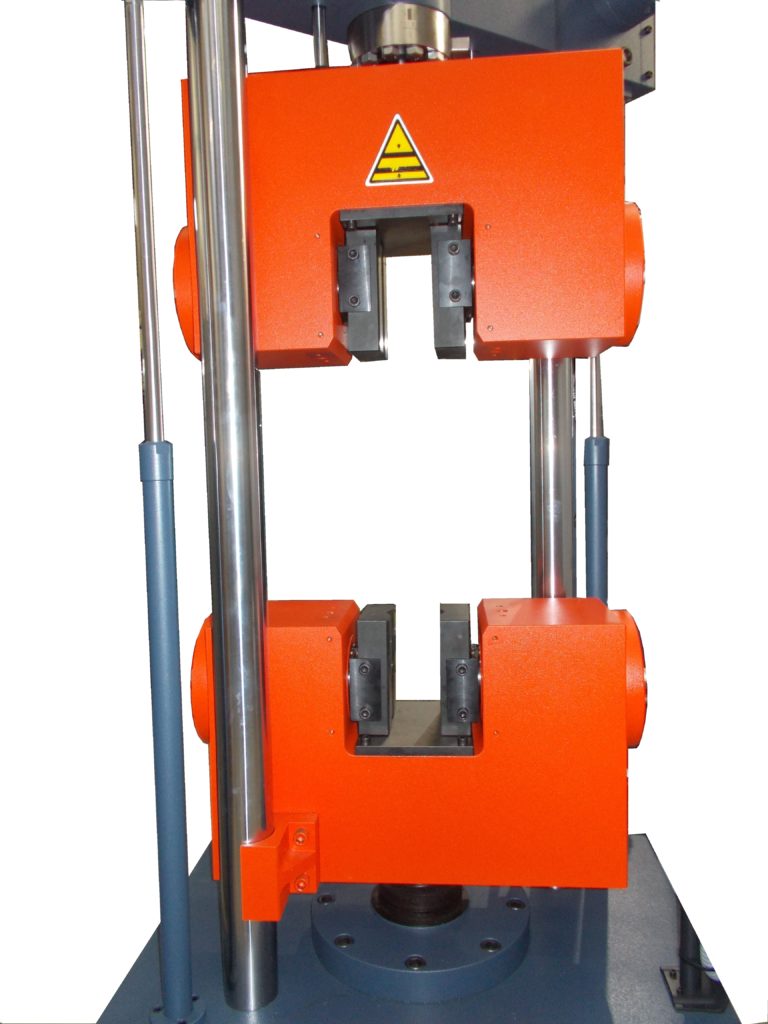
There are several types of tension grips available, each with specific characteristics and applications. Some of the most common types are:
- Mechanical grips These grips are manually operated using a screw or lever. They are simple and easy to use, but may require more time to grip and release the sample compared to other types of grips.
- Hydraulic grips These grips use a hydraulic system to quickly and precisely hold and release the sample. The
- Pneumatic grips These grips use compressed air to hold and release the sample. The pneumatic system provides a quick and secure grip, as well as allowing precise control of the applied force.
Each type of grip has advantages and disadvantagesand the choice depends on the specific requirements of the test and the user's preferences.
Key features of tension grips
When selecting tension grips, it is important to consider various key features that will affect the quality and accuracy of the test results. Some of these features include:
Force range and load capacity:Tension grips are designed to handle different force ranges, from low-load applications to high-strength tests. It is essential to choose grips that fit the required force range for the specific test.
Accuracy and repeatabilityTension grips must provide accurate and repeatable measurements. This involves the ability to apply force evenly to the sample and accurately record the readings from the load cell.
Compatibility with different types of samples and geometriesThe grips must accommodate a wide range of sample shapes and sizes. This may include flat, cylindrical, round, tubular samples, among others. The ability to properly grip different sample geometries is essential for obtaining reliable results.
Material and design The grips can be designed to fit different types of machines and work under varying humidity and/or temperature conditions. Therefore, it is essential to select the appropriate material and design for each case.

Importance of tension grips in material testing
As we have mentioned, tension grips play a fundamental role in material testing and offer various advantages in evaluating the mechanical properties of materials. Some of the key applications of tension grips include:
Determination of tensile strengthTension grips allow measuring the maximum force a material can withstand before failure. This is essential for evaluating the quality and strength of materials used in numerous applications.
Evaluation of ductility and elongationTension grips measure the deformation and elongation of the sample during the test. This provides information about the material's ability to deform before failure, which is crucial for determining its behavior under different load conditions.
Analysis of the modulus of elasticityTension grips are also used to calculate the modulus of elasticity of a material. This provides information about the stiffness and the material's ability to return to its original shape after elastic deformation.
Characterization of fatigue resistanceTension grips are used in fatigue testing to assess the material's resistance to cyclic loading. This is especially important in applications where the material is subjected to repetitive stress during its lifespan, such as in structural components.
Innovation in tension grips: Servosis as a market leader
Servosis It stands out as a market leader by providing innovative and customized solutions in tension grips, ensuring accurate and reliable results. We offer our clients the following benefits:
- Advanced solutions in tension gripsWe offer a wide range of tension grips with precise speed control systems and adaptive load capacity.
- Customization and adaptability to specific needsWe provide customized solutions based on the test requirements and the type of sample. This ensures optimal compatibility and accurate results.
- Quality, precision, and technical supportWe offer high-quality products that meet the industry's most demanding standards.
By trusting Servosis, our clients receive high-quality testing equipment backed by solid technical support, ensuring the safety and performance of materials used in a wide range of industrial applications.
¡Get in touch with us To learn more about tension grips!