

In sectors such as automotive, aerospace and structural engineering, ensuring the safety and durability of materials is a priority. Dynamic testing makes it possible to evaluate the behavior of materials and components under cyclic loads, vibrations and impacts, replicating real conditions of use and anticipating possible failures.
Servosis, as a leader in testing machine technology, offers advanced solutions for performing dynamic tests with precision and reliability. In this article, we explore the main types of dynamic tests, their application in different industries and Servosis' state-of-the-art technology that allows these tests to be carried out with maximum accuracy.

What is Dynamic Testing and why is it essential?
Dynamic tests are mechanical tests in which materials or structures are subjected to time-varying stresses. In contrast to static testsIn the dynamic tests, the load is applied gradually and constantly, while in the dynamic tests the load fluctuates continuously or in rapid pulses, simulating real operating conditions.
These tests are used to evaluate:
- Material fatigueresistance to repeated load cycles.
- Impact resistanceenergy absorption: capacity to absorb energy in the event of shocks or collisions.
- Vibrations and resonance: response to oscillatory stresses.
- Dynamic creepBehavior under sustained loads over time.
Its application is crucial in sectors where component safety and longevity are critical, such as the manufacture of vehicles, aircraft and civil structures.
Types of Dynamic Tests and their applications
2.1 Fatigue Tests: durability under repetitive loads
Fatigue testing is used to determine the strength of a material or component subjected to repeated stresses over time. This type of test is crucial in industries such as automotive and aerospace, where parts must withstand millions of load cycles without fracturing.
Main characteristics:
- They are made with controlled load in tension, compression or bending.
- Sinusoidal, triangular or square load profiles are applied.
- They make it possible to determine the S-N curve (stress vs. number of cycles)which defines the useful life of the material.
A practical example:
In vehicle chassis manufacturing, fatigue tests are performed to ensure that structural components can withstand vibrations and repetitive loads without premature failure.
2.2 Impact Tests: evaluation of impact toughness
Impact tests analyze the ability of a material to absorb energy under a sudden and rapid load. They are essential in protective designs such as safety helmets, bumpers and aircraft structures.
Common methods:
- Charpy EssayFracture toughness test: evaluates fracture toughness in metals and plastics.
- Weight drop testsimulates real collisions or impacts.
- Ballistic penetration testused in shielding and protection materials.
A practical example:
In the rail industry, impact tests ensure that the structural materials of railcars withstand accidental impacts without fracturing.
2.3 Vibration Tests: analysis of stability to oscillatory forces
Vibrations can cause resonance, structural damage and premature failure of mechanical components. Vibration testing helps to validate designs and optimize structures to avoid destructive effects.
Technologies used:
- Electromagnetic exciters to simulate sinusoidal or random vibrations.
- Servo-hydraulic shakers for long-term testing under extreme conditions.
- Frequency response analysis (FRF) to identify vibration modes.
A practical example:
In aviation, structural panels must pass vibration tests to ensure that no destructive resonances are generated in flight.
Contact with our team of experts and find out how our solutions can optimize your validation processes. Talk to a specialist
Servo Technology for Dynamic Testing
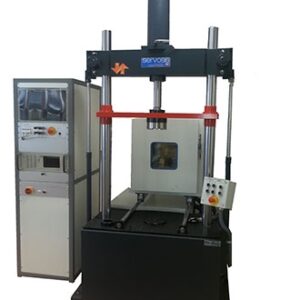
At Servosis, we have advanced technology to perform dynamic tests with precision and reliability. Our systems include:
Servo-Hydraulic Actuators
- Capable of applying dynamic loads with high frequency and precise control.
- Designed for fatigue and vibration testing of heavy-duty components.
High Frequency Data Acquisition Systems
- Equipped with advanced sensors to capture rapid load and deformation variations.
- Software with adaptive PID algorithms to stabilize measurements under varying load conditions.
Advanced Control Software
- Customized load profiles can be programmed.
- Real-time adjustment to adapt to complex dynamic test conditions.
Key Factors for Accurate Dynamic Testing
To ensure the repeatability and accuracy of dynamic tests, it is essential to consider:
- Accurate sample alignment to avoid erroneous voltage concentrations.
- Use of PID control algorithms to maintain stability under oscillating loads.
- Correction of thermal effects in prolonged tests to minimize variations in material behavior.
Dynamic testing is an indispensable tool to guarantee quality and safety in highly demanding sectors. At Servosis, we offer state-of-the-art technology to perform tests with maximum precision and reliability.
If your company needs solutions for fatigue, impact or vibration testing, contact us. Our team will help you find the best solution for your dynamic testing needs.