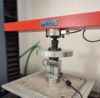


What are fatigue tests?
La fatiga is a phenomenon whereby the rupture of materials under cyclic dynamic loads occurs more readily than under static loads.
Fatigue tests are a method for determining the behavior of materials under fluctuating loads. A specified average load (which may be zero) and an alternate load are applied to a specimen and the number of cycles required to cause a failure.
What is your goal for this type of testing?
Fatigue tests has a clear objective and that is to analyze the resistance characteristics of different materials when working under variable loads. Among these materials we can find rotating drive shafts, anchor bolts, bars, various structures, pivot shafts, shock absorbers and even asphalt or bituminous mix (to see how deterioration evolves with the passage of time and progressive degradation).
Among the fundamental parameters that qualify the characteristic fatigue behavior of materials are:
- La kinetics of the applied load over time.
- Type of voltages generated in the part, as a consequence of the application of the load.
- Type of work characteristic of the part as a whole in the machinery.
- The type of work, type of stresses and kinetics of loading determine a wide variety of fatigue tests.
Fatigue testing machines
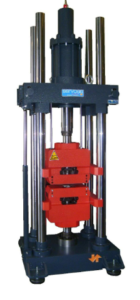
At Servosis we have the latest machines for fatigue testing of materials, among them the SERIES MUF 401 and the SERIES MUF 404:
SERIES MUF 401
Designed to meet fatigue test requirements at medium and high frequencies up to approx. 100 Hz. and with load capacities between 1 and 25 tons.
They incorporate 2 columns on which the upper bridge slides, which is hydraulically operated and locked. From 20 t and above, and depending on the use to which the machine is going to be dedicated, 4 columns can be mounted to achieve greater rigidity.
The hydraulic cylinder is normally mounted on the upper movable bridge, although it can be mounted on the lower bed on request.
This type of machine is equipped with a special type of servocylinder:
- Mod CH-9, hydrostatic type. The sealing rings at the outlet are eliminated and a suction group for oil drainage is incorporated. Max. working freq. 100 Hz
The stroke of the upper bridge is normally 800 mm to adapt the axial span to different types of specimens to be tested.
A large number of fatigue test fixtures such as tensile grips, bending fixtures, etc. can be included.
The lateral span between columns is 500 mm, and if required, for example, in case of incorporating a climatic chamber, 800 mm.
SERIES MUF 404
These frames are of cyclic type in low and medium frequency.
Designed to meet ISO 12106, UNE 36065 EX, LCF fatigue tests ASTM E606, etc. specifications.
The cylinder is always located on the upper bridge. All versions incorporate 4 columns.
This series incorporates hydraulically operated side clamping jaws of the 4013 ALH series.
One of the main uses for which these machines are designed is for performance of tensile and cyclic tests on round metal specimens.
They are built for forces between 50 and 250t. For lower load capacities we would count on the previous one MUF-401 seriesbetween 2 and 60t.
As with all our hydraulic frames, the upper bridge is hydraulically moved and locked, and the axial spans can be adapted to the type of fatigue tests to be performed, although the standard version is usually 700mm.
The type of cylinder incorporated in this type of machine is of the Mod. CH-4 (quasi-static) for frequencies up to 10Hz. AND CH_9 for higher frequencies, with variable strokes depending on the intended use of the machine, the standard stroke is 200mm.
PCD2K Software for your control
Both machines are controlled by nuestro software PCD2KThe user has different possibilities for its use:
The general-purpose options, with which the maximum performance possibilities are available for testing. The customer can configure your test in a personalized way and process the data afterwards.
The test windows under customized Standard, with which you have the maximum simplification in the realization of a specific test, by bringing together in one window only the necessary elements The results of all calculations required by the standard can be obtained directly from the test results. These windows are always custom-designed of the needs of the trial and of the customer upon request.
On the same machine as many test standards can be installed as desired with no other limitation than the maximum load capacity imposed by the machine and the maximum speed, determined by the hydraulic unit.
The fatigue test report will show the Standard under which the test was performed, the test parameterization, the machine data and the fatigue test results, as well as the Force/Strain graph.

Previous
Next
If you are interested and would like to know more about our fatigue tests, please see our fatigue machines section, and if you have any doubt or suggestion you can contact us through the contact form.