



With the help of the tensile testing machines or universal testing machines tensile tests are carried out, a mechanical material testing method to determine the characteristic values of the materials.
According to the type of material to be tested, the method is used in accordance with the respective standard to determine the values of the yield strength, maximum force, and elongation at break, among others.
Tensile tests
The tensile test can be carried out in different types of test tubes;
- One of the most characteristic is the ribbed steel bar, both in carbon steels and stainless steels or aluminum. In this type of products, Servosis is one of the main suppliers of equipment for the leading national steel groups.
- At narrow machined specimens to determine the behavior of the material under uniaxial loading uniformly distributed across the specimen's section.
- At notched specimens for the simulation of multiaxial stress states.
- At products, such as cables and wires, threads, films and sheets, ropes, molding elements, components, or component groups.
What should we take into account when performing a tensile test?
To perform a tensile test, we must have the necessary equipment, among which, as we have already mentioned, the Traction machinesWhich consist of two parts:
1- The load-generating deviceIt can be servo-hydraulic, servo-mechanical or pneumatic and has a fixed and a movable head.
2- The load and displacement measuring device, which is electronic, regulates the application of the load, and generates the diagrams that reflect the behavior of the specimen.
Analysis of the data collected from the tensile test
With the curve obtained from the tensile test, we would have access to the measurements of the elastic deformations, its creep, plastic deformations and striction, which would give us access to data such as the limits of proportionality or of elasticity. Only in this way, we will be able to ensure that the chosen material will or will not fail when performing the functions it is assignedthat is, that manufacturers can obtain a complete profile of their tensile properties.
In the test report, it will appear the Standard under which the tensile test was performed, the machine parameterization, machine data and tensile test results, in addition to the Graph curve Force/Deformation.
At ServosisWe offer the best machinery to perform this type of tests and we also have six models adapted to meet the different needs of our customers.
These are the models that make up our catalog of Traction machines; ME 402, ME 405, MUE 403 and MUE 404.
Serie ME-402
The testing machines of the series ME-402cover the range of low loads for quasi-static tests on all types of materials, such as: plastics, rubbers, steels, aluminum, construction materials, soils, asphalts, etc.
The precision in measuring the analog channels of force and displacement meets the Class 1 of the EN7500-1 Standard.
They are built with capacities ranging from 0.1 to 30 t. They are built in floor-standing or desktop formats. Their versatility allows them to be used in most standardized tests, being able to work both in tension and compression, with the appropriate tooling, within the same space.

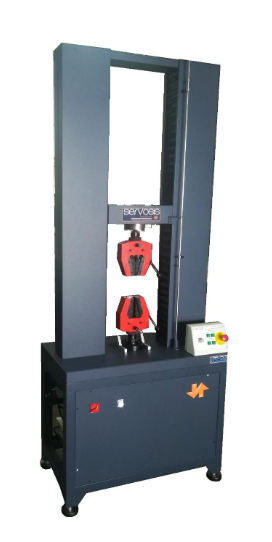
Series ME-405
The testing machines of the series ME-405 They cover the range of low loads for quasi-static tests on all kinds of materials, such as plastics, rubbers, steels, aluminums, etc. The precision complies with the Class 1 of the EN-7500-1 Standard.
They are built with capacities from 0.5 to 50 t. Their versatility allows them to be used in most standardized tests, being able to work both in tension and compression, with the appropriate tooling, within the same space.
It basically consists of a test frame, side columns (depending on the capacity there can be 2 or 4), an upper beam, a lower beam, a load cell, jaws, measurement and control equipment, consisting of a PC and the control software PCD2K.
Series MUE-403
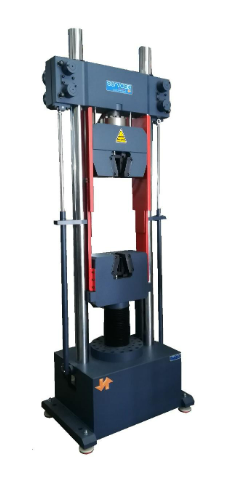
The testing machines of the series MUE-403 they allow carrying out static and dynamic tests with different capacities, from 5 to 100 Tm, up to 5 Hz.
Designed primarily for testing steels and rigid materials, both in round, flat, and corrugated bars, it also allows testing of any other type of material.
They have high stiffness (higher than 1Fn/mm), low maintenance, easy installation, wide variety of tests, quick placement of different samples, among other features.
The entire system is hydraulically servo-controlled, including the drives of the jaws, movements, and locking of the upper beam.
Series MUE-404
The testing machines of the series MUE-404 They allow carrying out low-frequency static and dynamic tests in tension and compression in the same space, through a double-acting cylinder controlled with a servo valve.
They are used mainly for tensile tests on metallic specimens, both in round, flat, and corrugated bars.
The working load capacities range between 60 and 200 Tm. (Upon request, up to 500 Tm.) When these machines are used for static tests, hydraulic units with flow rates between 13 and 38 l/min are installed, achieving displacement speeds of approximately 3 mm/s.
In dynamic tests, the flow rate will be studied as a function of the tensile test. Maximum working frequency 10Hz.

For more information about our Traction machines, inquiry our catalog and if you have any doubt or suggestion you can contact us through the contact form.

