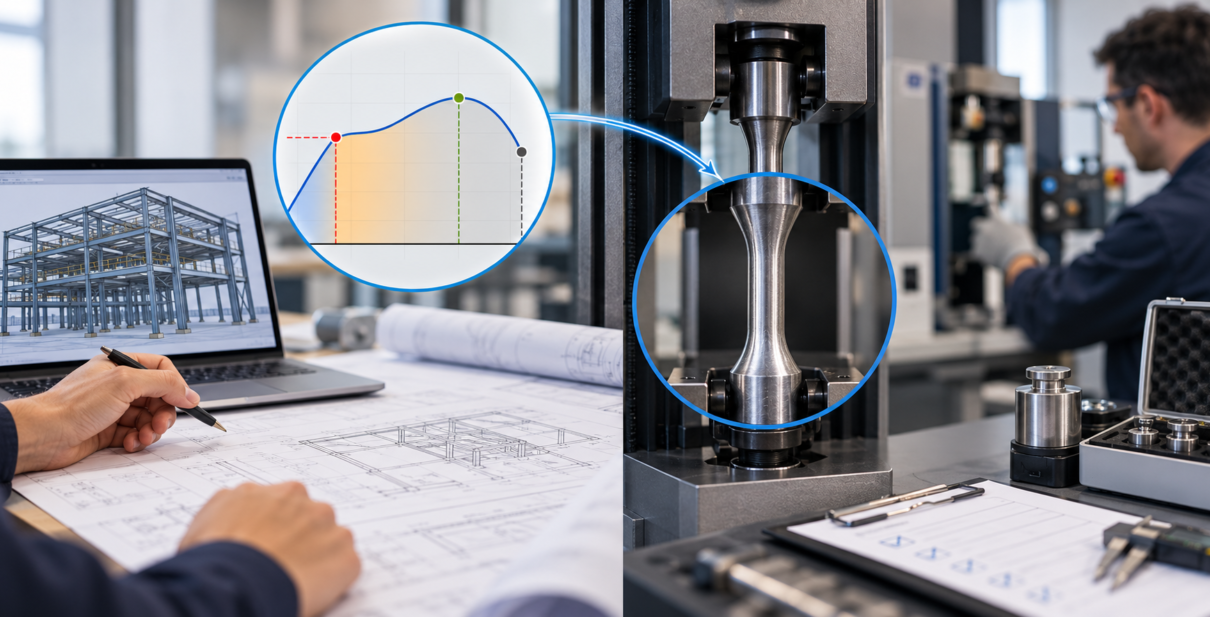
- October 19, 2026
- by Pedro Álvarez
- News
Elastic steel limit: definition, formula and how to determine it in tensile testing
“What is the elastic limit of this steel?” is one of the questions that are most frequently repeated in quality control and engineering, and it is also one of the questions that is most often confused with similar concepts, such as the yield strength or the Young's modulus.
It’s not a minor nuance: if you get it wrong when interpreting it, you could end up with a design that’s more expensive than necessary or, in the worst case, with a structure that can’t handle what it’s supposed to.
In this guide, we explain clearly what the elastic limit of steel is, how it is obtained, in what units it is measured, and how it is determined step by step in a tensile test.
What is the elastic limit of steel?
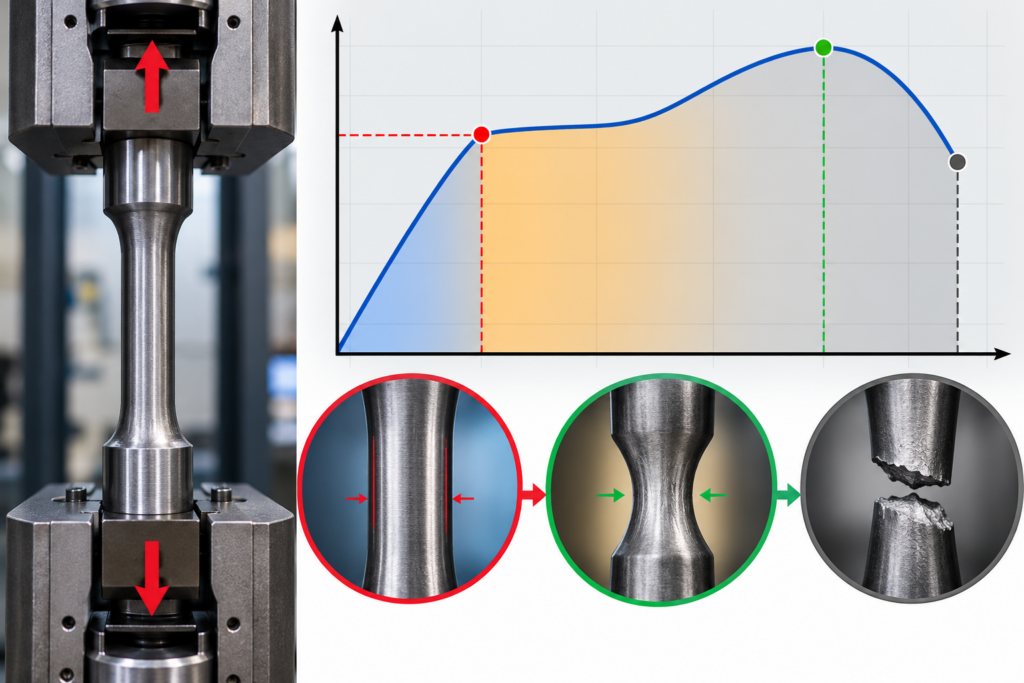
The elastic limit is the point at which a material stops behaving like a spring: up to that point, if you apply a force and then release it, it returns to its original shape. After that point, the material is permanently deformed, even though it has not yet broken.
In the world of steel you will encounter two ways of naming this figure, and it is advisable not to confuse them:
- Re: It is used when the steel shows a clear point where it stops stretching in a straight line, which is typical for steels with low carbon content.
- Rp0.2: is used when that point is not so clear at a glance. In practice, it is the stress value at which the material remains with a permanent deformation of 0.2%, a way of saying “this is the elastic behavior up to here” even though the change is not immediately visible in the curve.
In most structural steels, the value you will find in the quality certificates is Rp0.2.
How is the elastic limit calculated?
Here is something important to clarify: the elastic limit is not obtained with a direct mathematical formula, as if it were a physics equation. It is always determined through a real test: a sample of the material is stretched and observed at which point it stops behaving elastically.
Nevertheless, there are two simple ideas, with their formulas, that help you understand what happens during the rehearsal:
The tension that the material undergoes at every moment:
σ = F / A₀
That is, the force applied (F) is divided between the area of the sample section (A₀). The result is expressed in MPa.
And, while the material behaves elastically, that tension is directly related to how much it deforms (known as Hooke's Law):
σ = E · ε
Where E It is the Young's modulus, a measure of how rigid the material is, and ε It is how much it has stretched. This relationship stops being valid at the elastic limit: it is the moment when the material “breaks” from that predictable behavior and begins to deform permanently.
In practice, to calculate the Rp0.2, an imaginary line is drawn parallel to that first straight part of the curve, shifted a little (by 0.2%), and it is seen where it intersects with the actual test curve. It sounds more complicated than it is: nowadays the software in the machine automatically calculates it, based on what it records. Extensometer.
In which units is the elastic limit measured?
The elastic limit is measured in units of pressure, that is, of force distributed over a surface. In Spain, and generally in European regulations, the one you will most often see is the MPa, although there are others that still appear in some documents:
Unit | Where you're going to see it |
|---|---|
MPa (N/mm²) | It is the standard in European regulations and in current quality certificates. |
kgf/cm² | It still appears in old technical documentation or in some Latin American countries. |
psi | Common in technical documentation of Anglo-Saxon or American origin |
A practical tip: if you work with suppliers from outside, be sure to check which unit the data is expressed in. Confusing kgf/cm² with MPa is an easy mistake to make, and it can lead you to think that a material can withstand much more than it actually can.
How is the elastic limit determined in a tensile test?
The procedure follows the ISO 6892-1 standard, which we explain in detail in our guide on tensile testing in steel. In summary, the steps are:
- A sample of the material is prepared with the measurements specified by the standard.
- It is placed in the jaws of one universal testing machine, Well centered.
- An extensometer is installed, which is the one that accurately measures how much the material stretches as the force is applied.
- The force is applied gradually, at a controlled speed, while the load cell it is recording the data.
- With these data, the test curve is drawn, and the elastic limit is located on it.
The final result depends on these three points being properly taken care of: that the machine is calibrated, that the extensometer is accurate, and that the sample is well prepared. If any of these fails, the data you get is not reliable, no matter how well the rest of the process has been followed.
Elastic limit values according to the steel type
As a reference —without replacing the certificate for each specific batch—, these are the usual minimum values set by the regulations for the steels most commonly used in Spain:
Type of steel | Minimum elastic limit | Where it is used |
|---|---|---|
S235JR | ≥ 235 MPa | General-purpose metal profiles and structures |
S275JR | ≥ 275 MPa | Higher-demand metal structures |
S355JR | ≥ 355 MPa | High-strength structures, civil engineering |
B500S (corrugated) | ≥ 500 MPa | Armored concrete armor |
Stainless steel (AISI 304) | ≈ 190-220 MPa | Food industry, chemical industry, architecture |
In Spain, these values are not just a technical fact: they are the ones required by the Technical Code of Construction and the regulations for reinforced concrete to validate a structure. Therefore, a well-done test is, in essence, the document that certifies that a work meets the requirements of the law.
Elastic limit, tensile strength and Young's modulus: they are not the same thing
These are three distinct data that are easily confused:
- The límite elástico It tells you how much the material can stretch without becoming deformed forever.
- La tensile strength (Rm) It tells you how long it can withstand before breaking.
- The Young's modulus It tells you how rigid the material is, that is, how much it stretches for each unit of force applied before reaching the elastic limit.
Put another way: the Young modulus explains how steel behaves at the beginning; the elastic limit marks the point at which it can stretch without breaking; and the tensile strength indicates how much it can withstand in total. These three data, together with the elongation, are what give you a tensile test complete.
Why is this data so important?
The elastic limit is one of the data that engineers use to calculate structures: as long as a piece works below that value, it should not suffer permanent deformations during its lifetime. A mistake here — due to a poorly calibrated extensometer or a poorly prepared sample — can affect the entire calculation of a structure.
Therefore, in addition to following the rules properly, it is crucial to have well-calibrated and maintained equipment. If you want to check the traceability of your results, at Servosis we offer: calibration and maintenance services of testing machines.
Frequently asked questions about the elastic limit of steel
What is the difference between Re and Rp0.2? Re is the elastic limit when it is clearly seen in the test curve. Rp0.2 is the value used when that point is not so visible, and corresponds to a permanent deformation of 0.2%.
In which units is the elastic limit of steel measured? Normally in MPa, which is the standard unit in Spain and in European regulations. It can also appear in kgf/cm² or in psi in documentation from other countries.
Can the elastic limit be calculated without performing an experiment? Not reliably. It depends on the exact composition and the manufacturing process of each batch, so only a standardized tensile test gives a value that can be certified.
Which steel has the higher elastic limit, S275 or S355? The S355 has a guaranteed minimum of 355 MPa compared to the 275 MPa of the S275.
What equipment do I need to determine the elastic limit of a steel? A universal testing machine with the appropriate capabilities, specific grips, calibrated load cell, and above all, a reliable extensometer: without precise measurement of deformation, this data cannot be calculated properly.
Do you need to accurately determine the elastic limit of your materials or check if your testing equipment is properly calibrated to do so? At Servosis, we design and calibrate tensile testing machines for laboratories throughout Spain. Contact our team and we advise you without obligation.