

- 2 September 2026
- by Oscar Fernández
- News
In this article we explain in simple terms what destructive testing is, what the most common types are, what regulations govern each one, and how to know which machine you need, whether for testing a material, a manufactured part, or a complete assembly.
What are destructive material testing methods?
A destructive test consists of testing a sample to the limit: it is stretched, compressed, bent, or subjected to repeated stresses until it breaks or permanently deforms. It is called that precisely because the sample does not survive the test.
And here it is worth clarifying something important: the material is not always tested in its raw state — what in the sector is called a prototype. It is also possible to test a piece that has already been manufactured, to check whether it behaves mechanically as designed, or even an entire assembly, such as a car’s gearbox. In the latter case, it is usual to subject the entire system to a fatigue test to see how it withstands day-to-day use, not just the material from which it is made.
The underlying idea is the same in all three cases: by pushing it to its true limit, you get reliable data about how a component will actually behave once it is in service. This is different from non-destructive testing, which examines a part from the outside or inside (for example, with ultrasound or X-rays) without damaging it, but which does not tell you how much it can withstand before failing.
In practice, they are the basis of any serious quality control in sectors such as metallurgy, construction or automotive: they confirm that a material, a component or an assembly really meets what it promises, and not just what the supplier's technical specifications say.
Destructive vs. non-destructive testing: Which do you need?
Before looking at the types, it is worth clarifying this difference, because many material laboratories combine both approaches depending on what they need to test:
Destructive tests | Non-destructive tests | |
|---|---|---|
What to rehearse | It breaks or becomes deformed (material, part or assembly) | It remains intact and can be used as before. |
What does it say to you? | How long it lasts and how the material behaves | If it has internal or surface defects |
When to use it | Certifying a batch, validating a manufactured part, or testing an entire assembly | Checking already manufactured or in-service parts without damaging them |
Examples | Traction, compression, flexion, hardness, fatigue, torsion | Ultrasound, magnetic particles, radiography |
Put simply: if you need to know how much a material, a piece, or a complete assembly really holds before it fails, you need a destructive test. If what you want is to check something that has already been manufactured without damaging it, then you are interested in a non-destructive test.
Most common types of destructive tests in a laboratory
Ensayo de tracción
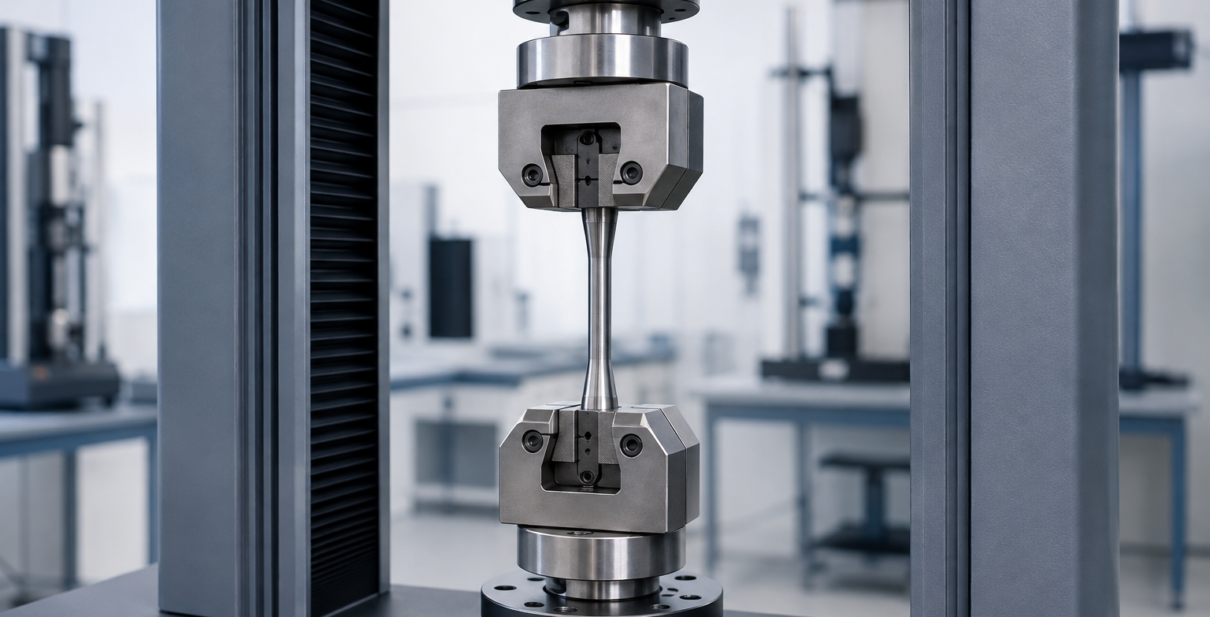
It is, without a doubt, the most requested essay in any Materials laboratory. It consists of stretching a sample until it breaks, while recording how it deforms as the force increases. From there, the most important data about the material are extracted: how much it can withstand, how far it can be stretched without being damaged, and at what point it breaks. This is done in a universal testing machine, And if you work specifically with steel, we recommend our complete guide on the tensile test on steel.
Compression test
It is, in a way, the opposite test: instead of stretching the sample, it is compressed. It is the most common for concrete, mortars, rocks and other fragile materials, where it is more interesting to know how they hold up when crushed than when stretched. You can read more in our article about compression tests.
Flexion test
Here, the sample is supported on two points and force is applied in the center, almost as if we were bending it with our hands. This is common in materials such as castings, ceramics, or welds, where it is of interest to know how they behave when bent, rather than when stretched.
Hardness test
It measures how much a material’s surface can resist being marked or penetrated by something, using methods known as Brinell, Vickers or Rockwell. The damage it leaves is minimal, almost a small mark, so some do not consider it a “destructive” test in the strict sense, although it does leave a permanent mark on the piece.
Fatigue test
It consists of repeating an effort many times—sometimes millions—to see how long something lasts before breaking due to accumulated wear. It is key in parts that work under repeated stresses, such as vehicle axles or components, but it also applies to complete assemblies: a gearbox, for example, is usually subjected to a fatigue test as a whole system, not just as individual parts. It requires specific equipment, such as our fatigue machines; if you are interested in the details, you can read more about it How long does a fatigue test take?.
Twist test
Here, the sample is rotated about its own axis to see how it withstands such an effort; this is especially relevant for threaded axes and connections. If you work with these types of connections, you may be interested in our content on Preload tests on bolted joints.
What regulations regulate destructive testing?
In Spain and Europe, these types of tests follow the existing UNE-EN and ISO standards, primarily to ensure that two different laboratories reach the same result when testing the same material in the same way. This is essential when your report is to accompany a certified work or an approved industrial project.
As a reference, here are the rules you are likely to encounter depending on the type of test:
Essay | Reference legislation |
|---|---|
Traction in metals | ISO 6892-1, UNE-EN ISO 6892-1 |
Compression in concrete | UNE-EN 12390-3 |
Flexion | UNE-EN ISO 7438 |
Hardness (Brinell, Vickers, Rockwell) | UNE-EN ISO 6506, 6507, 6508 |
Fatigue | ISO 1099 |
Calibration of the testing machine | ISO 7500-1 |
If your laboratory works with ENAC accreditation, keep in mind that regular calibration of your equipment is as important as following the test procedure properly.
What machine you need based on the test and the material
There is no single machine that is suitable for everything, although the name “universal machine” may give that impression. The choice depends primarily on three things: what experiment you need to perform, how much force you will have to apply, and what type of material you will be testing. As a general guideline:
- For traction, compression and flexion in metals, plastics or composites: one universal traction-compression machine, With the appropriate capacity for the material you are going to test.
- For bricks and rocks: Compression presses of greater capacity, designed for that type of material.
- For fatigue: teams capable of applying repeated efforts in a controlled manner over long periods of time.
- For Twist and preloadSpecific torsion benches.
A common mistake, especially in growing laboratories, is to buy a machine larger than necessary “just in case”, or, conversely, to be short of equipment and not be able to test the most resistant materials required by a new project. If you have doubts about which equipment suits your laboratory, at Servosis we analyze your case without obligation through our team.
Common errors when certifying destructive tests
- Not calibrating the machine at the frequency required by the standard: an essay done to perfection with an unschooled team is useless. You can see our work here calibration and maintenance services.
- Preparing the sample poorly: dimensions outside tolerance or careless machining invalidate the result even before it has started.
- Practicing at the wrong speedEach standard sets speed ranges; speeding up the process to “gain time” alters the values obtained.
- Choosing the wrong essay: request a tensile test when what really needs to be certified is the fatigue behavior, for example.
- Not recording the rule followed In the final report, something that quality audits usually review first.
Frequently asked questions about destructive testing of materials
What is the difference between a destructive and a non-destructive essay? The destructive method takes the sample to its breaking point or permanent deformation to determine how much it really holds; the non-destructive method checks for defects without damaging the part, which remains usable afterwards.
What is the most common destructive experiment? The tensile test, because from a single sample several key data—strength, elastic limit, elongation—can be obtained with a single machine.
Do I need a different machine for each type of test? Not always. A well-equipped universal machine covers traction, compression, and flexion. Fatigue and torsion usually require more specific equipment.
Which standard should I follow for a tensile test on steel? ISO 6892-1, which is the reference in Spain and Europe. You can see the complete procedure in our article about it. tensile test on steel.
How do I know if my laboratory needs to renew its testing equipment? If your machines no longer provide the capacity required by new projects, or have been out of calibration for a long time, now is a good time to check them. We explain more in our article about modernization of testing machines.
Does your laboratory need to define which destructive test to apply or renew the equipment to do it with guarantees? At Servosis we have been equipping material laboratories throughout Spain for years. Tell us about your case and we help you choose the right machine and configuration, without obligation.