

- 25 September 2026
- by Cristina Gonzalo
- News
Servosis at Advanced Manufacturing Madrid 2026: this is what we will be showcasing at the stand
On November 4th and 5th we return to Advanced Manufacturing Madrid, the annual meeting of advanced manufacturing in Spain. If you visited our stand last year and saw the testing machine in action, this time you’ll also find a durometer, a cobot for loading and unloading samples automatically, and a program with a completely revamped interface.
We’ll tell you what we’ll be bringing to IFEMA Madrid, what you’ll be able to see live, and why. Beyond manufacturing test machines, this year we want people to get to know another side of what we do.
What is Advanced Manufacturing Madrid and why we return every year
Advanced Manufacturing Madrid celebrates its 18th edition in 2026 and occupies halls 2, 4 and 6 of the exhibition center. IFEMA Madrid, With more than 600 exhibiting companies in machinery, automation, robotics, industrial digitalization, additive manufacturing, and advanced materials, the 2025 edition brought together about 13,000 professional visitors. This year, the fair has just been recognized as an international trade fair by the Secretariat of State for Commerce, which says a lot about where it is headed.
Admission is free if you register in advance, and the opening hours are from 9:30 to 18:00 on both days. For us it is the benchmark fair of the year: it is where the most customers from laboratories and industrial plants from all over Spain visit the stand in two days, and where we usually show things that we have not yet published on the website.
The star of the stand: the M-402, a machine weighing 500 kilograms
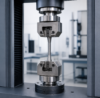
This year the center of the stand is the M-402, a machine with a capacity of 500 kg designed for tensile and compression tests. With it, the two most requested tests can be performed in any laboratory. Materials laboratory: stretch a test tube to see how much it can withstand and how much it deforms, or compress it to see how it behaves under that kind of stress.
If you work in quality control, in a university lab or in a plant that needs to certify materials, now is a good time to see it in action up close and ask our technical team directly what configuration would suit your needs for testing. You can read more about this type of equipment in our guide on what a quality control system is. universal testing machine.
More live teams: durómetro and cobot
Alongside the M-402 we will be bringing a hardness tester. It’s a simple device to understand even though it sounds technical: you lightly touch the surface of a material and, depending on the mark it leaves, it calculates the surface hardness. If you’ve never seen one in action, you can try it yourself at the stand.
We will also have a cobot: a collaborative robotic arm designed to automate the loading and unloading of samples. It is not a testing machine, but it gives a very visual idea of where automation is going in laboratory and plant processes.
How an elastic limit test looks like in real time
Over the two days, we will be performing live demonstrations of an elastic limit test: the point at which a material stops behaving like a spring and remains deformed forever, even though it has not yet broken. It is a simple test that anyone can follow even if they aren't technically inclined, and it is a good way to understand in just a few minutes something that in a laboratory report sometimes takes hours to explain in words: how a technical datasheet becomes a fact proven by experience.
If at some point you see the cobot repeating the same gesture over and over again—picking up, pressing, releasing—it’s pretty similar to how a fatigue test conceptually works: subjecting a material to repeated effort, sometimes millions of times, to see how much it can withstand before failing due to accumulated wear and tear. This isn’t the test we’re going to do with the machine we’ve been using this year, but it serves to give you an idea of what it entails.
The novelty of 2026: a clearer and easier-to-use interface
This year we have launched a new software interface for our testing machines. The change is not just aesthetic, although it is also noticeable: we have worked on what in the sector is called the HMI (Human Machine Interface), the part that the laboratory technician interacts with every day to launch an experiment, read results, or adjust parameters. We wanted it to be more pleasant to use and more intuitive, especially for those who haven't been using the same software for years.
Why accuracy keeps rising, and where AI is headed in trials
Quality standards in the sector continue to grow, so we continue to work on increasing the accuracy of our machines and control systems, so that the results of one machine are reliable from test to test. In parallel, we are starting to develop tools with artificial intelligence and data science so that customers can download and analyze the results of their tests more automatically. It is still in the development phase, but it is a service that we hope to be able to offer soon.
What we are looking for in this edition (and something that many people don't know we do)
At a fair like this, we primarily look for three things: meeting people from the sector who don't yet know us, closing meetings with current clients, and showing the equipment in person, something that no technical specification can fully replace.
But there is a fourth reason, and it is the one that is least visible from the outside: many customers who have been working with us for years only know us as manufacturers of testing machines, and they don't know that we also offer calibration and maintenance services. If your team hasn’t been reviewing for a while, or you just didn’t know we were doing it, the stand is a good time to ask about it. For us, it’s not a separate service: a well-calibrated machine today has to continue delivering reliable results within five years, and that doesn’t depend solely on how it’s manufactured, but also on how it’s used.
If you think about it, the M-402, the durometer, the cobot and that same calibration service all respond to the same idea: it’s useless for something to work well on the first day if it doesn’t continue to do so for the fifth year. That’s why we insist so much that the engineering at Servosis is designed to last, and a fair like this is, above all, the opportunity to demonstrate it in person.
We are waiting for you at Servosis, from November 4th to 5th
Dates | November 4 and 5, 2026 |
Hours | 9:30 a.m. to 6:00 p.m. |
Place | IFEMA Madrid, halls 2, 4 and 6. Servosis stand: 4A06 |
Entrance | Free with prior registration |
If you want to secure a meeting with our technical team during those two days, contact us before the fair and we will arrange it for you in advance.
Frequently asked questions about Servosis at Advanced Manufacturing Madrid 2026
When and where is Advanced Manufacturing Madrid 2026?
From November 4 to 5, 2026, at IFEMA Madrid, distributed among halls 2, 4 and 6. Servosis stand: 4A06
Is the entrance free?
Yes, as long as you register first as a professional visitor through the official website of the fair.
What will Servosis exhibit at its stand?
A 500 kg M-402 traction and compression machine, a hardness tester and a cobot, in addition to live demonstrations of elastic limit tests.
Can I schedule a meeting with the Servosis team during the fair?
Yes. Please contact us first via the contact form and we will reserve a slot with the technical team for those two days.
In addition to manufacturing testing machines, what other services does Servosis offer?
We also offer calibration and maintenance of testing machines, something that many customers who already work with us still don't know what we do.
Can't you come to the fair but are you interested in any of the equipment we'll be showing?
Write to us and we see it without compromise, whether you are in Madrid or not those days.